
Choose a tray sealer from the largest tray footprint, height and flange geometry your tooling must accept, not from the machine’s outer frame dimensions. By the end, you will be able to convert Pune demand into a validated cavity and cycle requirement, check film and utility constraints, and specify the tests a supplier must pass before installation.
Key takeaways
- Measure the largest tray, rim, depth and film draw before selecting machine size.
- Convert shift demand into cavities per cycle and required sealing cycles per hour.
- Confirm sealing method, film type, compressed air, power and ventilation requirements.
- Demand sample trials, seal tests and changeover evidence before approving a supplier.
Start with the tray drawing, not the machine footprint
Specify tray sealer size from the drawing of the largest tray, not from the machine’s overall frame. A tray that matches the stated length and width can still fail if its depth, rim geometry, product overfill or lid-film draw exceeds tool clearance. Maximum tray height is a hard selection limit.
Your purchasing specification should identify:
- Tray length and width, stating whether each measurement is the cavity, outside rim or maximum tooling envelope
- Tray depth and the complete height range the machine must seal
- Flange width, corner radius and sealing-area dimensions
- Cavity count, mould position and spacing between cavities
- Permitted tray tolerances, including variation in depth, rim level and flange flatness
Do not accept “suitable for your tray size” as a technical commitment. Ask the tray sealer supplier for the maximum-tray drawing, tool layout and the exact height range, then check your product at its highest fill level. The tool must also leave clearance for film draw without dragging product across the seal.
Before approval, require a trial using your own trays, lidding film and product. Record seal integrity, film registration, rejects and sustained packs per minute for each cavity configuration.
A packaging machine manufacturer tray sealer in Pune should also confirm the tool envelope, changeover method and utility schedule in writing; an empty-machine cycle rate proves little about physical fit.
Turn shift demand into a cavity and cycle requirement
Convert the finished-tray target into a sustained rate before choosing cavity count. Required cycles per minute = required finished trays per minute ÷ cavities per cycle ÷ expected operating availability.
For example, 12,000 trays in an eight-hour shift equals 25 trays per minute at 100% runtime. At 85% availability, a single-cavity machine must sustain about 29.4 cycles per minute; a four-cavity tool needs about 7.4 cycles per minute.
Build the calculation from your actual shift data:
- Saleable trays required per shift, plus the expected reject allowance
- Net production minutes after breaks, cleaning, film changes and planned changeovers
- Verified operating availability, including loading delays, jams and minor stops
- Candidate cavity counts that fit the tray layout and the required cycle rate
- Separate rates for each tray format if the line changes sizes during the week
Use saleable output, not the empty-machine speed printed in a quotation. If you expect a 2% reject rate, divide the required saleable quantity by 0.98 before calculating cycles. A four-cavity tool increases output per index, but it also increases tooling cost, film consumed per index and the number of trays lost when one cycle fails.
For a tray sealer in Pune, compare weekly output after format changes, not just the fastest cycle. A two-cavity tool that changes quickly can outperform a four-cavity tool that requires heavy tooling exchange, temperature stabilisation and lengthy first-off checks. Ask for a sustained pack-per-minute result using your trays, film and product.
Account for sealing method, film and site utilities
Simple heat sealing usually needs less cycle time and fewer utilities than MAP, but the process also changes the machine specification. Vacuum pumps, gas controls and pipework can require a larger frame, more floor space and higher connected load. Size the machine against the validated rate with the chosen process running.
| Process | What changes | What to specify |
|---|---|---|
| Heat sealing | Shorter dwell and no gas circuit | Seal temperature, dwell time, pressure and seal width |
| Vacuum sealing | Evacuation adds cycle time and pump demand | Target vacuum, evacuation time and pump capacity |
| MAP | Evacuation, gas flushing and sealing extend the cycle | Gas type, inlet pressure, residual-oxygen target and permitted leak rate |
Do not approve lidding film because its width matches the tool. Match its heat-seal layer to the tray material—PET, PP, CPET or coated paper—and validate temperature range, dwell time and seal type on the actual tray lot. A mismatched sealant causes peeling, scorching or leaks.
For a Pune installation, obtain model-specific figures for:
- Connected and peak electrical load
- Compressed-air pressure, quality and consumption per cycle
- Gas consumption per cycle, drainage and ventilation requirements
Ask a tray sealer machine supplier for the utility schedule and a speed figure recorded with vacuum or MAP active, not an empty-machine cycle. Acceptance-test the machine with your trays, film and product; record sustained packs per minute, seal integrity, rejects, residual oxygen, film registration and jam recovery.
Compare formats by changeover and hygienic access
A multi-format tray sealer improves weekly output when rapid tool exchange, recipe loading and first-off approval save more time than the extra tooling and cleaning require. If four SKUs run twice per shift, a slower machine with a 10-minute validated changeover can beat a faster machine that needs 45 minutes.
| Format | Weekly advantage | What cancels it |
|---|---|---|
| Single-format, high-cavity tool | Maximum sustained output for one dominant tray | Long stoppages when another SKU needs a different tool |
| Multi-format quick-change tool | Fewer machines and faster switching between compatible trays | Heavy tools, alignment errors, recipe mistakes and seal-temperature recovery |
| Flexible, lower-cavity tool | Easier handling, cleaning and product segregation | Lower packs per cycle and more film consumed per packed unit |
Count the complete changeover, not just tool removal. Include lifting and locking the tool, film-roll replacement, recipe selection, temperature stabilisation, cleaning, trial packs and seal verification. Record the time until saleable packs resume.
Hygienic access decides whether flexibility pays. Require tool surfaces, sealing plates and product-contact zones to be reachable without dismantling guards, and check whether trapped crumbs or condensate can drain. A four-cavity tool also creates more cavities to inspect and more rejected trays when one cycle fails.
Ask a packaging machine manufacturer in Pune to demonstrate each format using your trays, film and product. Compare sustained packs per minute, reject rate, cleaning duration and recovery after a jam; an empty-machine speed proves very little.
Specify the supplier proof before you approve the machine
Approve the machine only after the supplier proves that its tooling, utilities and output match your actual line. A “suitable for your tray size” statement is not enough; require the maximum tray length, width, depth, flange width, corner radius, cavity count and allowable tolerances in writing.
1. Request the maximum-tray drawing, tool layout, film-roll specification, utility schedule, validated speed by cavity count, recommended spare-parts list and service-response terms. The drawing must show whether each dimension refers to the tray cavity, outside rim, mould position or maximum tooling envelope.
2. Confirm the largest tray depth and complete tray-height range the machine can seal. If you need two formats, require the tooling drawings, changeover steps, changeover time and confirmation that both formats fit without unlisted parts.
3. Complete a Pune site check before installation. Record verified electrical supply, compressed-air pressure and quality, air consumption per cycle, gas availability and consumption per cycle, drainage, room temperature and available floor access.
4. Run a factory acceptance test with your trays, lidding film and product. Record sustained packs per minute, seal integrity, reject rate, film registration, printed-mark control, residual oxygen for MAP, format changeover time and recovery after a jam—not an empty-machine cycle.
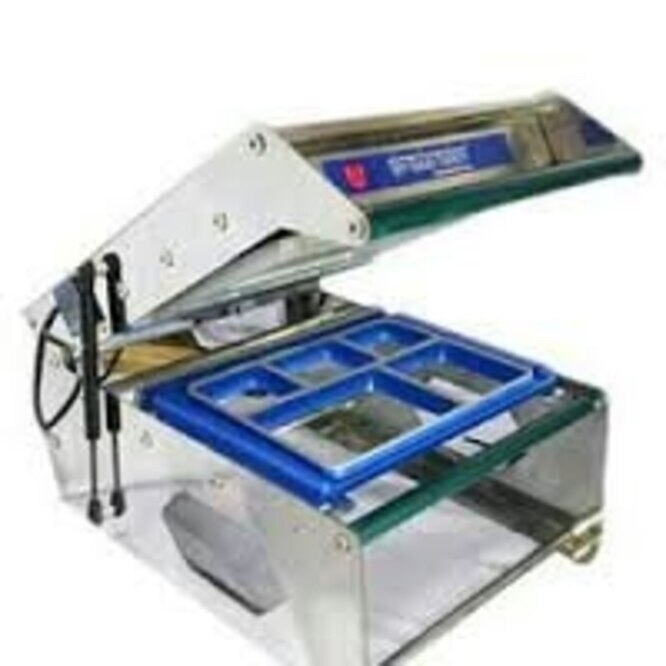
ASN Packaging PVT LTD should provide these figures for its quoted SPTS-200 configuration rather than leaving them implied by catalogue dimensions. Compare the approved test record with the site acceptance test before releasing final payment. A packaging machine manufacturer in Pune that will not document these limits leaves you carrying the sizing risk.
Related product
 | ₹22500 Model SPTS-200 Voltage (V/Hz) 220/50 Total Power(W) 650 Tray size(LxW)mm 190 x 142, 136 x 101 (250 gm Two tray) Sealing Speed Per Hour 350 to 500... View product → |
Frequently asked questions
How should you begin selecting a tray sealer size?
Start with the largest tray drawing and check length, width, depth, rim geometry, product overfill and lid-film draw against tool clearance.
How do you calculate the cavity and cycle requirement?
Convert shift demand into trays per hour, then select the cavity count and cycle rate that meet output without exceeding the machine’s practical operating limit.
Which utilities must you confirm before ordering a tray sealer?
Confirm the sealing method, film specification, electrical supply, compressed-air pressure and consumption, ventilation, drainage and available floor space.
What should you compare beyond the machine footprint?
Compare tool changeover time, access for cleaning, product-contact materials, guarding, film loading and access to sealing and cutting components.
What proof should a tray sealer supplier provide?
Request trials using your trays, film and product, along with seal-integrity results, cycle data, changeover demonstrations, utility figures and service documentation.