
Choosing a tray sealer requires more than comparing tray dimensions and hourly output. You need to match the machine’s sealing method, tooling, film, tray material, utilities and quality controls to the foods you pack, then verify the combination with product-filled trials before purchase.
Key takeaways
- Match the tray flange, film and sealing temperature before buying equipment.
- Use pressure, heat and dwell controls to prevent leaks and short shelf life.
- Choose interchangeable tooling when products, tray sizes or volumes will change.
- Require leak, seal-strength and cycle testing before commissioning the machine.
How tray sealing works, and which food packs it suits
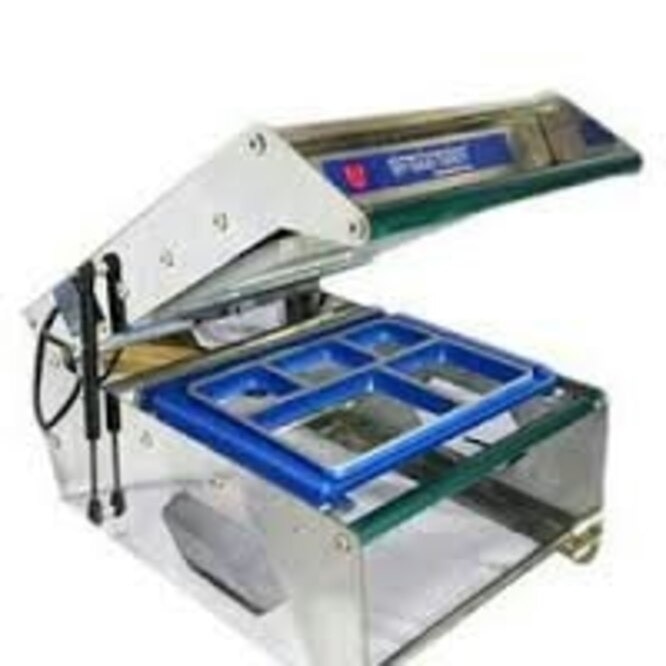
A tray sealer works by forming a hermetic seal between a rigid tray flange and lidding film. You load filled trays, place film over them, position the sealing tool, then apply heat, pressure and dwell time before cutting the film and unloading packs.
The rigid base supports presentation, portion control and tamper evidence for fresh meals, dairy, sauces and ready-to-eat foods.
- Heat-seal-only machines seal the film directly.
- Headspace flushing replaces air with gas but does not deeply evacuate the tray.
- A chamber-capable machine first evacuates air, then injects gas; vacuum-gas flushing gives tighter control of residual oxygen than ordinary flushing.
- Confirm whether the SPTS-200 supports vacuum, gas flushing and modified-atmosphere packaging before connecting it to shelf-life targets.
| Process | Best fit | Limitation |
|---|---|---|
| Tray sealing | Fresh meals, meat, dairy, produce, sauces and ready-to-eat portions | Needs matched tray, film and tooling |
| Vacuum packing | Flexible bags and compression-tolerant meat or dense foods | Poor fit for delicate products or rigid presentation |
| Hand lidding | Low-volume batches | Slow and inconsistent at scale |
| Band sealing | Bags and pouches | Does not seal rigid trays |
| Shrink wrapping | Outer bundling or tamper indication | Does not create the same tray-to-film hermetic seal |
| MAP | Products needing controlled oxygen and carbon dioxide | Requires product trials, barrier film and residual-oxygen validation |
When comparing a tray sealer in Pune, specify tray sealing equipment for the actual pack. A tray sealer for food processing must match film, flange and product conditions, not just a catalogue size.
How to match the tray, product portion and sealing film
A “250 g” tray format does not guarantee a 250 g portion. Density, fill height, headspace, sauce viscosity and product geometry determine the actual fill, so test the product in the proposed cavity rather than relying on the tray label.
1. Match the tray to the sealing tool. Specify PP, PET, CPET, aluminium, multilayer barrier or paperboard construction, including any coating. Ask the supplier to assess flange width, cavity depth, rim flatness, corner geometry, tray stiffness, mould requirements and whether a custom sealing tool is needed.
2. Match the film to the tray resin or coating. The sealant layer must bond correctly to that surface; an otherwise suitable film can produce weak, non-opening or leaking seals. Confirm total film width, thickness, peelable or permanent sealing, oxygen and moisture barrier, antifog treatment, print registration and eye-mark compatibility.
3. Match film handling to the tray sealing equipment. Printed film may require a servo film drive and registration sensor to keep graphics and cuts within the flange; clear film can use simpler indexing. Poor registration can leave inadequate sealing area even when heat and pressure are correct.
For a tray sealer for food processing, verify food contact for the complete construction: tray resin, every film layer, inks, adhesives and coatings. Check applicable requirements such as 21 CFR 177.1520 for US supply chains or Regulation (EU) No 10/2011 for EU markets, alongside the supplier’s declarations for the finished combination.
What sealing controls protect against leaks and short shelf life
A reliable seal comes from a validated process window, not a hot jaw. For a tray sealer for food processing, the jaw must deliver the specified temperature and dwell time at consistent pressure while the flange stays clean and flat.
Sauce, fat or product on the flange creates channels; extra heat can distort the tray, shrink the film or worsen seal-through contamination.
1. Request validated temperature, dwell-time and pressure settings for every tray-film combination. Do not accept a generic temperature range. Confirm that flange width, rim flatness and contact area remain consistent at the intended cycle speed.
2. Separate seal appearance and peel force from leak detection. ASTM F88/F88M assesses seal strength and peel behaviour; ASTM F2096 detects gross leaks in nonporous packs through internal pressurisation and bubble observation; ASTM F1929 suits channel-leak detection in porous or paper-based components. A neat seal is not proof of a leak-free pack.
3. For MAP, require residual-oxygen results using the intended product, headspace, tray, film and cycle speed. A gas-flow rating does not prove shelf life: evacuation sequence, gas flow, chamber leakage, product respiration and barrier performance all affect the result.
4. Ask whether the tray sealing equipment records recipes, alarms, rejects and actual process values for each format. Those records expose drift and make a failed pack traceable instead of leaving operators to guess which setting changed.
Fixed-format or interchangeable tooling: which machine architecture fits a Pune plant?
A quoted cycle time is not finished packs per minute. Loading effort, cavity count, film indexing and changeover time can reduce actual output, especially on a tray sealer industrial packaging machine in Pune.
| Architecture | Loading and output factors | Best fit |
|---|---|---|
| Fixed-format, single-station | Manual loading; one tool and footprint; simplest film path and cleaning | One high-volume tray with few batch changes |
| Interchangeable-tool machine | Tool removal, storage, cleaning and recipe changeover add downtime; several footprints | Plants running multiple formats |
| Automatic inline | Continuous loading and film indexing; output depends on feeder timing and cavity count | Longer runs with consistent trays |
| Rotary | Multiple stations and cavities; higher theoretical output, but complex changeovers | High volume with limited format variation |
A fixed tool reduces complexity and suits one dominant product. Interchangeable tooling earns its cost when your Pune plant runs several tray footprints, but price each tool, its storage rack, cleaning time and measured changeover.
Ask how many formats one shift includes, how often batches change, how many cavities each tool holds and whether stored recipes recall the correct temperature, dwell, pressure and film position.
Require the same product-filled trial, tooling list, utility schedule and changeover measurement when comparing a quotation from ASN Packaging PVT LTD with other industrial packaging machine in Pune suppliers.
Before choosing a tray sealer in Pune, check electrical supply, compressed-air pressure and dew point, gas purity and pressure stability, extraction and cleaning access. Inspect the sealing tool, film path and conveyor for exposed threads, crevices and dirt traps. A machine that looks fast in a catalogue may demand more labour per finished pack.
Related product
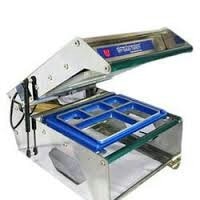 | ₹22500 Model SPTS-200 Voltage (V/Hz) 220/50 Total Power(W) 650 Tray size(LxW)mm 190 x 142, 136 x 101 (250 gm Two tray) Sealing Speed Per Hour 350 to 500... View product → |
What acceptance testing should prove before commissioning
1. Run the industrial packaging machine in Pune with the actual tray, lidding film, product temperature, fill height, headspace and intended production speed. Record sealing temperature, dwell time, pressure, vacuum or gas settings, film registration, cut position, seal appearance, seal strength, leak results, reject rate and changeover time.
2. Test both clean flanges and representative contamination from sauce, fat and product particles. A clean trial can hide weak seals that fail during production. Require a matched tray-film combination for the tray sealer for food processing, because PP, PET, CPET, barrier laminates and board-based trays need different settings and tooling.
3. For MAP, measure residual oxygen throughout the planned production run using filled trays; one empty tray proves nothing about evacuation, gas flushing or package consistency. Select the leak test for the package: bubble-emission testing suits nonporous packs, while dye penetration is useful for porous or paper-based structures.
Keep the test reports with the production recipe.
4. Before accepting the tray sealing equipment, verify that the complete construction—tray, film layers, inks, adhesives and coatings—meets the destination market’s food-contact rules. Inspect the sealing tool, film path and conveyor for dirt traps, exposed threads and inaccessible crevices, then confirm compatibility with the plant’s cleaning method.
Use the results to decide whether each product suits tray sealing, whether a vacuum packing machine is better, and whether extra tooling or a vacuum-gas, MAP-capable architecture is justified.
Frequently asked questions
How does an industrial tray sealer work?
It places lidding film over filled rigid trays, then applies heat, pressure and dwell time to form a hermetic seal before cutting the film.
How do you match a tray, product portion and sealing film?
Check the tray material and flange dimensions, product depth and portion weight, then select film that is compatible with the tray and sealing temperature.
Which sealing controls help prevent leaks and short shelf life?
Control sealing temperature, pressure and dwell time, and verify the result with seal inspection and leak testing.
Should a Pune plant choose fixed or interchangeable tooling?
Choose fixed tooling for stable, high-volume production with one format; choose interchangeable tooling when tray sizes, products or production requirements will change.
What should acceptance testing prove before commissioning?
Testing should confirm the specified cycle rate, consistent seal quality, leak resistance, correct film cutting and reliable operation across the intended tray and product formats.