
A roll that matches only the nominal strap width can still jam at the guide, fail at the weld head, or overload the dispenser. You will be able to compare the strap, roll, machine interface, and package load as one system before approving a supplier or placing an order.
Key takeaways
- Match strap width, thickness, core, and outer diameter to the machine path.
- Specify strength, elongation, edge profile, embossing, and weld performance together.
- Calculate expected strap use from package dimensions before choosing roll length.
- Approve the roll with a production trial using real packages and settings.
Start with the machine path and package geometry
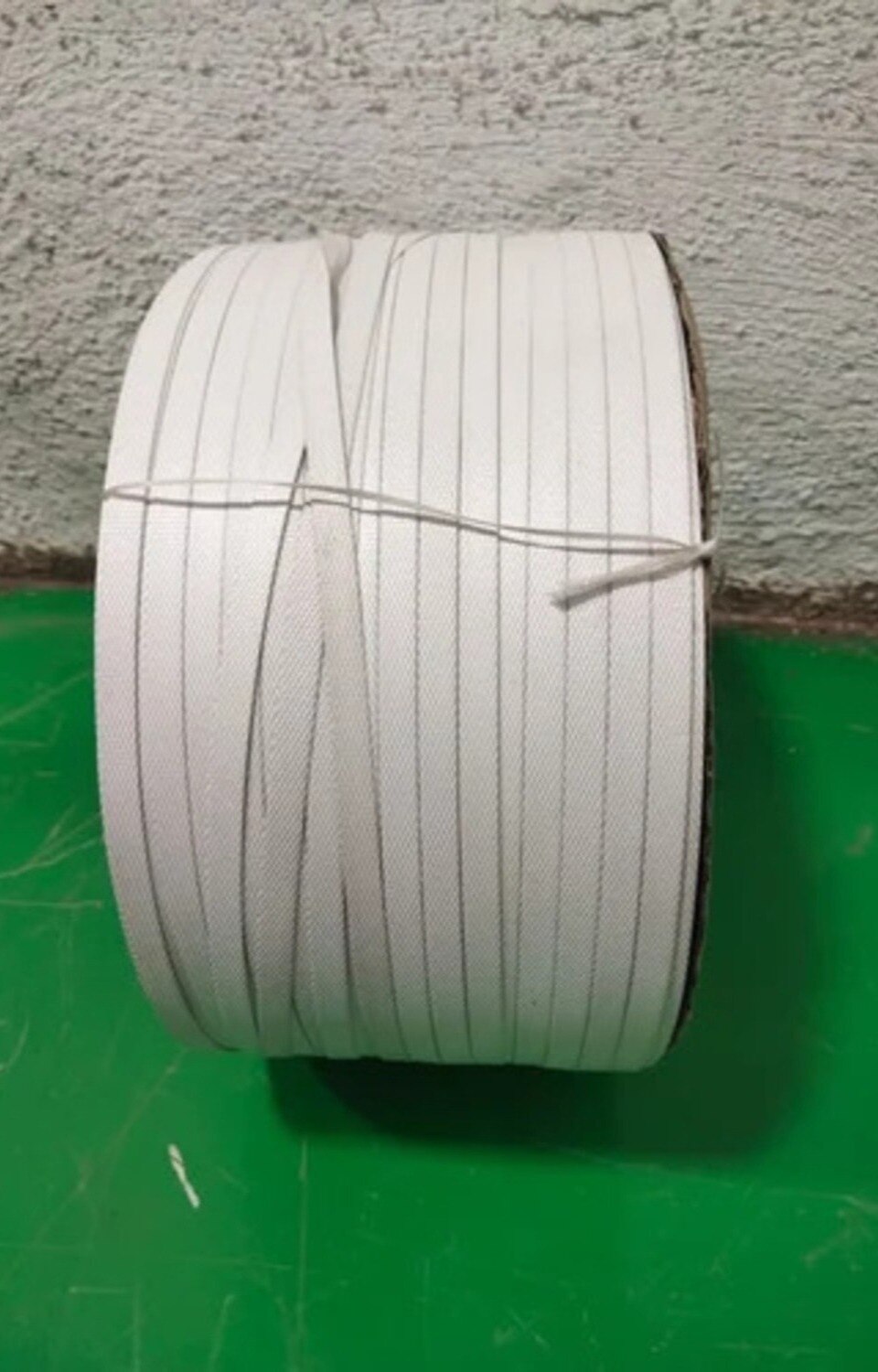
A plain PP strapping roll fits only when its width and thickness match the strap channel, feed rollers, tensioner, sealing or welding head, and cutter. A nominal 12 mm roll can jam or produce weak joints if its actual thickness, edge profile, embossed surface, core diameter, or outer diameter falls outside the machine limits.
Manual and battery-operated machines tolerate operator handling but still need the correct guide width, roll mass, and joining method. Semi-automatic and automatic machines also depend on feed-roller grip, payout direction, cycle speed, cutter clearance, and weld-head settings.
Do not force strap through a tight guide or change tension blindly; crushed edges, feed slips, and broken welds follow.
A weigh filler machine does not determine the strap specification by itself. Ask the weigh filler machine manufacturer for plain PP strapping roll selection data covering the complete line: filled-bag dimensions, sealing sequence, conveyor pitch, allowable compression, and strapper limits.
Match the strap to the load-bearing geometry. On filled sacks, keep it away from flexible walls and leak-prone seams; on cartons, food cases, bundles, bricks, and textiles, place it on a stable bearing area and avoid unstable corners.
Request these written limits before ordering:
- Supported width and thickness
- Allowable tension
- Core diameter and core width
- Maximum roll diameter and roll mass
- Joining method and weld-head compatibility
- Cutter clearance and guide dimensions
A strap that fits the product but not the machine is the wrong roll.
Choose width, thickness, strength, and weld performance together
Light-to-medium cartons and food cases usually suit a flexible plain PP strapping roll; heavier bundles, brick packs, textile bales, and filled bags need a wider or thicker grade only when the package can bear its compression.
Tensile strength alone is insufficient: retained tension also depends on elongation, stress relaxation, corner shape, weld strength, and the tensioner’s control method.
| Load type | Starting selection | Main check |
|---|---|---|
| Light cartons | Narrower, flexible PP strap | It must hold without crushing carton edges or slipping around corners |
| Food cases | PP strap with a stable bearing area | Avoid cutting into the case or damaging its closure |
| Brick packs and heavy bundles | Wider or thicker strap with controlled tension | Check compression tolerance and retained tension after settling |
| Textile bales | Strap that conforms without excessive elongation | Prevent strap embedding and tension loss |
| Filled bags | Width and thickness matched to the bag’s load path | Keep the strap away from flexible walls and leak-prone seams |
A heavier strap is not automatically safer. If it cannot conform to the load, feed cleanly, or weld consistently, it can deliver a weaker package than a lighter grade.
Confirm whether the head uses heat welding, friction welding, or a compatible seal. Resin formulation, surface condition, temperature, dwell time, pressure, and cooling all affect the joint. Test joint break strength using the actual machine head and intended strap grade, not a certificate alone.
ASTM D3950 is a reason to request complete material data. Replacing PP with PET is not a simple roll substitution: PET changes tensioner control, weld-head operation, and machine settings because it retains tension differently.
Use a complete specification sheet, not a width-only quotation
Request a complete specification sheet from every pp strap roll supplier before comparing prices. A quoted 5–19 mm width range proves only that some widths exist; it does not prove that each width is available in every thickness.
1. Record width in millimetres, thickness in millimetres, roll length in metres, net strap weight, core diameter, core width, maximum outer roll diameter, and dimensional tolerances. Ask for actual values, not “standard” or “approximately.”
2. Request strap colour, surface finish, breaking load, elongation, and weld compatibility. State whether plain means unprinted, smooth, uncoloured, or all three; distinguish smooth, embossed, printed, and coloured material, and disclose variable recycled content.
3. Demand a width-and-thickness matrix: for example, 9 mm at 0.50 and 0.60 mm, 12 mm at 0.55 and 0.70 mm, and so on for every offered width. Do not infer combinations from another machine, catalogue range, or product family.
4. Confirm the joining method and test data for the actual resin and surface. Embossing can improve feed grip, but it changes apparent thickness, contact area, friction, and weld behaviour.
5. Inspect sample rolls before approval. Reject telescoping, loose layers, crushed edges, splice points, and uneven winding; these faults cause loops, feed interruptions, cutter jams, and missed welds even when laboratory breaking-load results pass.
Treat these pp strapping roll specifications as a purchasing record, not a sales description. A width-only quotation leaves the machine fit and joint reliability unproven.
Calculate roll use and measure the existing machine before ordering
For one package, measure the strap path around the package, then add the overlap and weld allowance. Divide usable roll length by that figure to estimate cartons or bundles per roll. If each package uses two straps, multiply the figure by two before dividing.
Quoted roll weight does not reliably reveal length. Confirm what the supplier weighs:
| Basis | Included | Why it can mislead |
|---|---|---|
| Net strap weight | PP strap only | Useful for calculation, but excludes the core |
| Gross roll weight | Strap plus core | Core weight varies between suppliers |
| Packed roll weight | Roll, core, and packaging | Not a length specification |
For a rough engineering check, strap volume equals width × thickness × length. Use PP density of about 0.90–0.91 g/cm³, with width and thickness converted to centimetres, then allow for the core and winding variation. Treat the result as an estimate, not a promised roll length.
Before ordering, record these pp strapping roll specifications and machine measurements:
- Measure strap width with a vernier caliper and thickness with a micrometer.
- Measure core diameter and core width with a tape or calliper; measure the machine’s maximum roll diameter and dispenser clearance.
- Record actual roll mass, payout direction, strap-channel and guide dimensions, and the cutter clearance.
- Compare every value with the machine maker’s written limits, including supported width, thickness, core size, roll diameter, and mass.
A nominal 12 mm roll can still bind or feed poorly when its actual thickness, core, or outer diameter exceeds those limits.
Approve the roll through a production trial, not a certificate alone
A certificate can confirm tensile values, but only a production trial shows whether the roll survives your line. Run the trial with the intended bag material and fill weight, carton dimensions, conveyor pitch, discharge sequence, sealing sequence, and planned strap cycle time.
- Record continuous payout through the complete roll. Reject loops, telescoping layers, crushed edges, or uneven winding.
- Check that the strap passes the guides, feed rollers, tensioner, sealing or welding head, and cutter without rubbing, slipping, or jamming.
- Measure achieved strap tension, then inspect package recovery after tension. Excessive rebound can loosen the load; excessive compression can damage a filled bag or carton.
- Test weld or seal break strength using joints made by the production head. Count missed joints and inspect corner damage after discharge and handling.
- Time roll replacement, including removal, threading, joining, and restart. A roll that performs well but adds long stoppages can reduce line output.
Before approval, ask a weigh filler machine manufacturer in Pune or another equipment builder to provide written interface data:
- Supported strap width and thickness
- Core diameter, core width, and maximum roll diameter
- Permissible tension and required strap properties
- Joining method and compatible weld or seal settings
Give this document to each pp strap roll supplier and compare trial results against it, not against a certificate alone. ASN Packaging PVT LTD can support this handoff as a packaging-equipment manufacturer and supplier, but the approval decision belongs to the documented interface and on-line evidence.
Frequently asked questions
What must you check before ordering a plain PP strapping roll?
Check the machine’s strap-channel width and thickness limits, feed rollers, tensioner, sealing or welding head, cutter, core diameter, and maximum outer diameter. Compare these with the roll’s actual measurements.
Which plain PP strapping roll specifications matter besides width?
Request thickness, tensile strength, elongation, edge profile, embossing, roll length or net weight, core dimensions, outer diameter, weld performance, and material details. Width alone cannot confirm machine compatibility.
How do you calculate plain PP strapping roll use?
Measure the strap path around each package, add the tail length and allowance for the seal or weld, multiply by straps per package, and divide the roll’s usable length by that total.
Why is a production trial necessary before approving a PP strap roll?
A trial shows whether the roll feeds consistently, holds tension, seals or welds correctly, cuts cleanly, and runs without jams on your machine using actual packages.