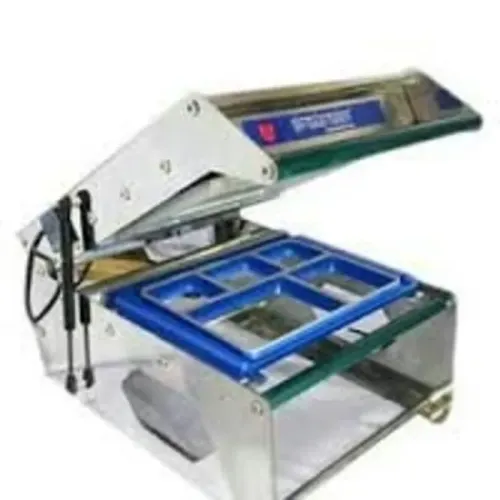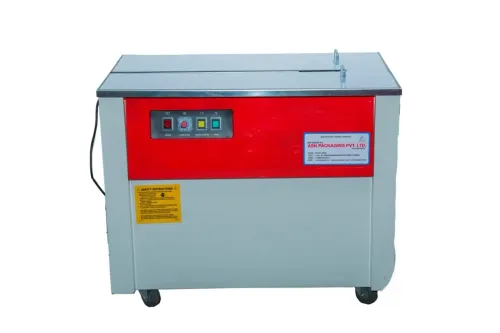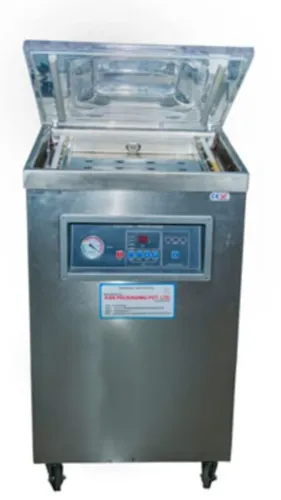

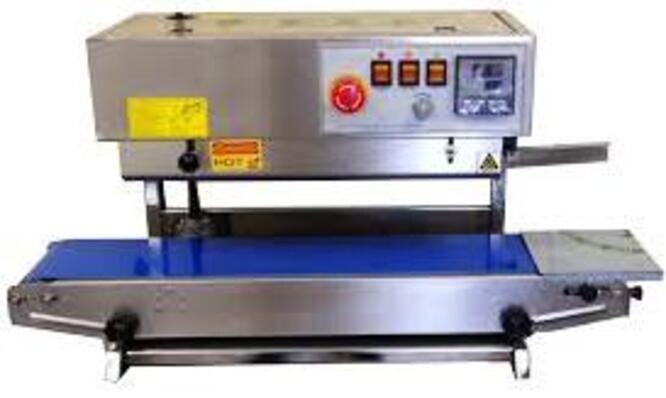
A band sealer pays for itself only when repeated pouch sealing consumes enough labour, creates enough inconsistency, or limits output to justify its purchase and upkeep. You will be able to estimate payback, match the machine to your film and product, compare horizontal and vertical formats with lower-cost alternatives, and test a Pune supplier before committing.
Key takeaways
- Calculate payback from sealed bags per shift, labour and rejected packs.
- Match sealing temperature and speed to the film’s actual heat-seal range.
- Test your filled pouch, product load and sealing orientation before ordering.
- Choose an impulse, vacuum or continuous sealer when your pack requires it.
When does a band sealer earn back its cost?
A band sealer earns back its cost when repeated pouch production turns faster, cleaner sealing into measurable savings. You load the pouch, guide its open edge, pass it through the heated sealing band, cool the seal, and collect the finished pack. The calculation must use sealed bags per shift, not the empty-belt speed.
Use this payback checklist:
- Record actual bags per shift after loading gaps, warm-up, product settling, rejects, coding, cleaning and changeovers.
- Measure operator minutes per bag with the current sealer and the band sealer, then multiply the difference by the loaded labour cost per hour.
- Add the cost of scrap from weak or wrinkled seals, including product, film, rework and disposal.
- Subtract added electricity, routine maintenance, belt and heater replacement, and planned downtime.
- Divide the supplier’s quoted price by the net saving per shift. The result is the estimated payback in shifts; divide by shifts worked per month for months.
There is no universal break-even quantity because a high-wage operation with costly rejects recovers its investment sooner than a low-volume operation with cheap labour. Ask a packaging machine supplier to validate the figures using your filled pouches and acceptance output.
Repeated production that demands consistent throughput favours a band sealer; occasional batches often favour a simpler impulse or pedal sealer with lower purchase and changeover costs.
How do film type, temperature and speed determine seal quality?
A 0–300°C display does not prove a pouch will seal well. Polyethylene, polypropylene, laminated pouches, metallised films and foil-laminated structures differ in thickness, coating and sealant layer, so temperature must match belt speed, pressure and dwell time.
The machine guides the open edge between heated bands, applies pressure, transfers the pouch through cooling, and releases the finished pack. Contamination from powder, oil or product residue interrupts that sequence and produces weak seals; uneven heating, worn PTFE bands and belt drift create inconsistent or wrinkled ones.
Run controlled trials in this order:
- Use the intended pouch, film lot, fill weight and sealing pressure. Start at a moderate temperature and speed, then inspect seal strength and appearance.
- For an under-seal that opens cleanly or peels apart, increase heat or reduce belt speed so the sealant receives more dwell time.
- For burn-through, scorching or sticking, reduce heat or increase speed. Do not solve a damaged film by adding pressure.
- For wrinkles or an uneven seal, correct pouch tracking and pressure, then check that both bands heat evenly.
A food band sealer machine needs cleanable seal paths when residue is likely. A pharmaceutical band sealer also needs documented parameter limits, calibration and qualification; its temperature range alone establishes nothing.
Approve settings from sealed samples made at start-up and steady state with the real product. An empty showroom pouch cannot reveal contamination, belt drift or a seal that fails after cooling.
Will the machine handle your pouch, product and orientation?
Buy only when the physical limits match your filled pack, not because the catalogue lists a high belt speed. Obtain written limits for maximum pouch weight, maximum pouch width, usable conveyor load, clearance beneath the sealing head, seal position, and recommended pouch orientation.
1. Choose horizontal sealing when dry products sit securely in pouches that can travel on a belt. Choose vertical sealing for liquids, sauces, powders, granules, or products that settle toward the bottom; this keeps the product below the seal.
2. Keep the seal area clean by leaving headspace, folding or guiding the pouch mouth upright, and controlling fill level and product settling. Product trapped in the seal creates channels and weak closures.
3. Require a demonstration using your filled pouch, product, fill weight, film lot, and intended orientation. An empty pouch hides contamination, distortion, and conveyor-loading problems.
For a food band sealer machine, inspectable surfaces, accessible cleaning points, and open conveyor geometry matter more than an extra few metres per minute. Reject exposed lubricant, flaking paint, and avoidable crevices that retain powder or sauce.
A pharmaceutical band sealer needs documented qualification rather than an assumption of compliance. Define cleaning instructions, calibration, seal-parameter limits, and IQ, OQ, and PQ or an equivalent plan.
Treat nitrogen flushing and coding as separate options. Demand measured gas flow and residual-oxygen performance where relevant, then approve readable codes on the actual film after sealing; pouch orientation, seal position, print area, ribbon compatibility, and cure time can defeat a mounted coder.
When is another sealing system a better buy?
Choose another sealing system when your workload, product or presentation does not justify continuous pouch handling. Compare the options against the job, not the machine name or maximum speed.
| Option | Best fit | Main limitation |
|---|---|---|
| Impulse sealer | Occasional, low-volume batches and short changeovers | Slower operator-controlled output |
| Pedal sealer | Medium-duty work, including wider bags | Requires manual positioning and cycle control |
| Vacuum sealer | Packs that need air removed before sealing | Adds vacuum-cycle time and may affect sensitive products |
| Heat-shrink system | Shrink film, tamper presentation or a tight outer wrap | Requires compatible shrink film and heating equipment |
| Band sealer | Repeated filled-pouch production with consistent seal placement | Higher maintenance and cleaning burden |
A band sealer machine supplier in Pune is the stronger choice when the same pouch format runs repeatedly and continuous movement reduces operator handling. It is a weaker buy for sporadic batches where an impulse sealer changes formats faster and avoids idle equipment.
Check the product before choosing. Vacuum sealing suits air-sensitive or space-saving packs; it does not replace a standard closure when removing air could crush the product. Choose heat-shrink equipment when appearance or tamper evidence matters more than simply closing a pouch.
A band sealer also brings more parts to maintain:
- Heated belt, conveyor and PTFE bands
- Heaters, thermocouples and controllers
- Bearings, tracking components and cleanable contact surfaces
Those parts add cleaning time, wear-item replacements and failure points. Compare the actual bags per shift, bag width, product sensitivity, air-removal need and desired presentation before accepting a quoted speed.
How should you test a Pune supplier before placing the order?
Do not accept a catalogue speed as proof of capacity. A packaging machine supplier in Pune should run a written acceptance trial with your pouch, film lot, product, fill weight and intended speed. Contaminate the seal area deliberately with the product; a clean, empty showroom pouch proves little.
Ask the supplier to record:
- Heater temperature and belt speed
- Start-up and steady-state samples
- Rejection rate and seal appearance
- Cleaning time and the accepted sealed-pouches-per-minute rate
| Check | Evidence to require | What failure reveals |
|---|---|---|
| Food packaging | Inspectable surfaces, accessible cleaning points and a documented cleaning method | Residue can remain in crevices or contaminate later batches |
| Pharmaceutical or sterile-barrier packaging | IQ, OQ, PQ or equivalent plan; calibration; seal-parameter limits; cleaning and change-control records | The machine is not automatically GMP-qualified |
| Package integrity | ASTM F88/F88M seal-strength testing, ASTM F1929 dye-channel testing or ASTM F2096 gross-leak testing where suitable; consider ISO 11607-1 and ISO 11607-2 for sterilized medical-device packaging | Temperature and belt speed alone do not prove integrity |
When comparing a band sealer machine supplier in Pune, request spare-parts stock locations, warranty exclusions, and response times for heaters, thermocouples, belts, PTFE bands, bearings and controllers. Ask ASN Packaging PVT LTD, or any other supplier, for a written service escalation route and named technical contacts.
Buy only when the tested output supports your payback calculation and the support plan survives these checks. A packaging machine supplier that refuses an agreed acceptance rate is offering a claim, not delivered performance.
Related product
 | ₹18500 Model : ASN 770 / ASN 800 / ASN 900 Voltage V/Hz : AC 220/50 Total Power (W) : 500 Sealing Speed (M/Min) : 0∼10 Sealing Width (mm) : 8 ∼10... View product → |
Frequently asked questions
When does a band sealer earn back its cost?
A band sealer earns back its cost when the value of faster output, lower sealing labour and fewer rejected packs exceeds its purchase, maintenance and operating costs. Calculate using sealed bags per shift rather than the machine’s empty-belt speed.
How do film type, temperature and speed determine seal quality?
Film construction sets the heat-seal range, while temperature and conveyor speed determine how much heat reaches the seal. Test the actual laminate or polyethylene film and inspect seal strength, wrinkles, burn-through and channel leaks.
Will a band sealer handle my pouch, product and orientation?
Confirm the pouch width, filled weight, headspace, seal direction and product sensitivity. Test filled pouches in the intended horizontal or vertical orientation, especially when the product is powder, liquid or granular.
When is another sealing system a better buy?
Choose another system when you need vacuum removal, gas flushing, hermetic pharmaceutical packaging, very wide seals, intermittent operation or a package format that cannot travel steadily through a continuous band sealer.
How should you test a Pune supplier before placing the order?
Ask a packaging machine supplier in Pune to run your own film, pouch and product. Record bags per minute, seal temperature, seal width, rejected packs, electrical requirements, spare parts, warranty terms and operator training.