
A low-volume exporter can waste money by automating a task that takes only a few minutes, or lose shipments by relying on hand wrapping that cannot contain the load. Use pallet volume, load behaviour, export route, operator time and total cost per accepted pallet to choose between film, strap and automation.
Key takeaways
- Count pallets per shift before comparing machine output.
- Use stretch film for containment; use straps when compression or sharp edges demand it.
- Measure pallet size, film width and operator workload before selecting equipment.
- Test service response, spare parts and compliance documents before purchase.
Choose the packaging method by pallet volume and dispatch pattern
Count pallets per shift before comparing machine output. Hand stretch wrapping suits very low or irregular volumes when an operator can walk around each pallet and maintain consistent overlap. It becomes wasteful when walking, film variation or rework consumes more time than the equipment costs.
| Option | Best fit | Main trade-off |
|---|---|---|
| Hand stretch wrapping | Very low or irregular volume; mixed dispatches | Lowest investment, but operator controls overlap and containment |
| Portable pallet wrapper | Changing wrapping points, varied pallet sizes, no fixed conveyor | Flexible, but requires floor handling and setup |
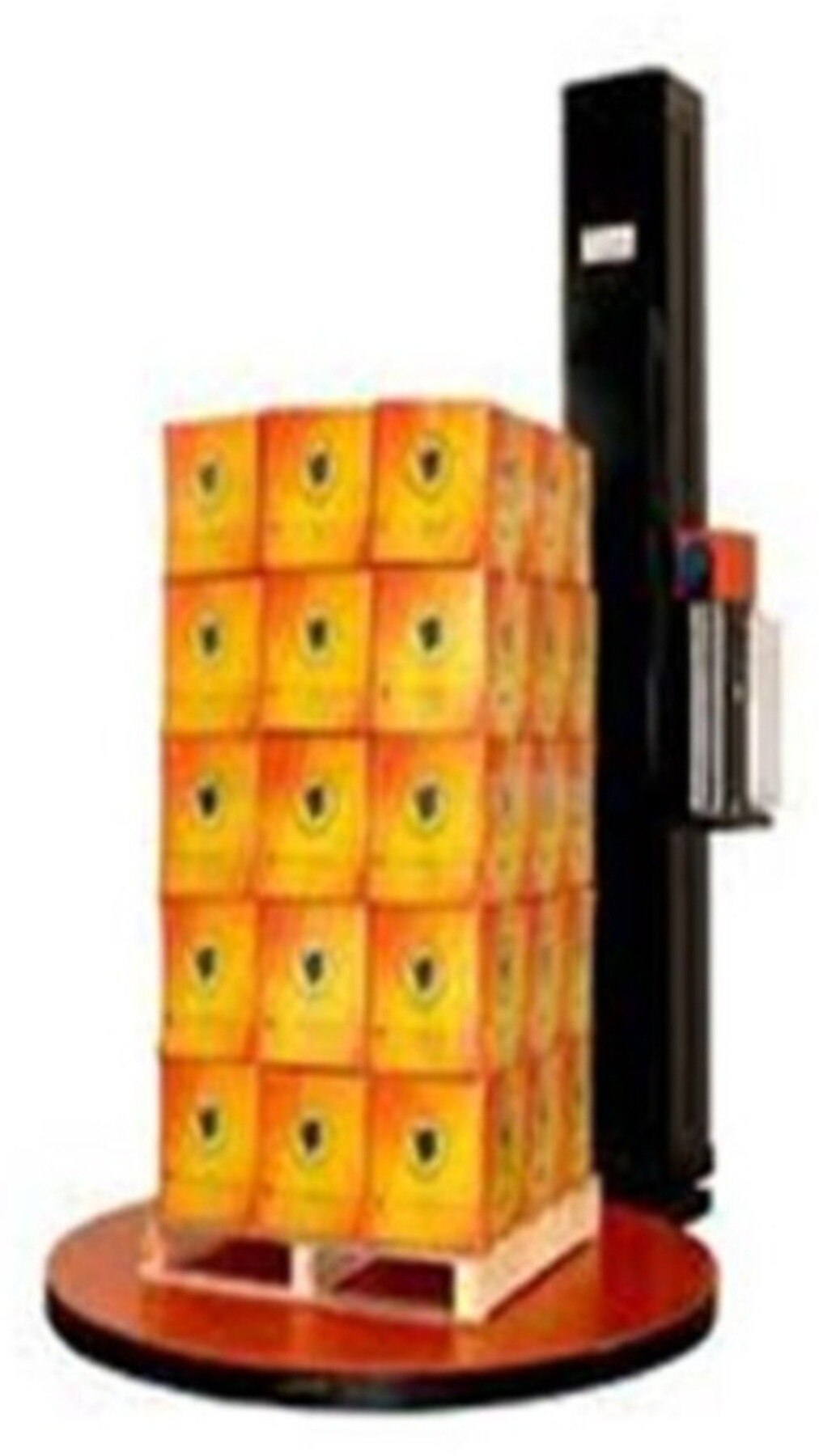
| Semi-automatic turntable wrapper | Repeatable pallet positions and moderate volume | Operator positions the load, attaches film and removes the wrapped pallet |
| Powered stretch wrapper | Higher daily volume, consistent film application or costly operator time | Requires floor space, electrical installation and maintenance |
| Fully automatic line | Stable high-volume flow with fixed pallet dimensions and conveyors | Difficult to justify for one export order at a time |
Compare total cost per accepted export pallet, including labour, film or strap, maintenance, rejected loads, rework, floor space, installation and service response. A portable pallet wrapper is attractive when pallets are dispersed; a semi-automatic machine fits a repeatable station. A powered unit earns consideration only when its consistency or throughput offsets infrastructure costs.
A small export packaging machine is the right choice when it lowers that total cost or materially improves load quality. Ask a pallet wrapping machine manufacturer for small export units to test your actual pallet range, film and dispatch pattern—not a standard demonstration load.
Match film or strap to the load and the transport risk
Resolve whether you need load unitisation, transport restraint, or both before choosing equipment. A pallet wrapping machine manufacturer can help contain cartons, but stretch film is not a cargo-securing system designed around vehicle acceleration, friction, blocking and lashing. Use the road or sea transport plan to decide whether separate restraint is required.
- Choose stretch film when you need continuous containment around cartons, reduced shifting between products, and protection from dust or light moisture.
- Choose PP or PET strap for tall, heavy, slippery or irregular loads that need concentrated restraint, puncture resistance or visible tamper evidence after a strap is cut.
- Specify the joint method, strap width and thickness, tension range, and corner protectors. Without edge protection, straps can crush carton corners.
- Test film and strap against carton crush, sharp edges, load movement and handling impacts. A combined method can use film to contain the unit and two or more straps to restrain it.
- Inspect the pallet separately. ISPM 15 applies to regulated solid-wood pallets, crates and dunnage in international trade; the IPPC mark confirms treatment, not capacity, dryness or structural integrity.
- Do not assume wrapping fixes an unmarked or weak wooden pallet. Plywood, oriented strand board and fibreboard are generally treated differently, so confirm the material and importing-country rule.
Film alone cannot make dangerous-goods packaging compliant. UN packaging, marks, labels and transport documents remain separate requirements.
Calculate machine fit from the pallet, film and operator workload
1. Give a pallet wrapping machine manufacturer for small export units your real operating envelope, not a demonstration pallet.
Supply pallet length and width, smallest and largest footprint, total load height, maximum weight, overhang or diagonal projection, load profile, carton fragility, film type, target cycles, power supply, fork-truck approach and clearance around the rotating table or arm.
2. Describe the workload in minutes. Record time for loading, unloading, film attachment, roll changes, cleaning and maintenance, then compare it with the operator time available per pallet. Include mixed-height cartons, sharp corners and unstable profiles; gross weight alone will not reveal collision, access or containment problems.
3. Calculate film use from the selected film grade, pre-stretch ratio, wrap pattern, overlap and load geometry. Do not convert a quoted pre-stretch percentage directly into guaranteed savings: film elongation, puncture resistance, tension and carton compression determine the usable result. Hand-wrap film can break on a powered carriage if its properties are unsuitable.
4. Request a trial with the actual film and pallet range, then set acceptance criteria before it starts:
- No film breaks or carton deformation
- Acceptable containment force at selected points
- No load movement after the planned fork-truck and export handling sequence
- Repeatable results across the smallest and largest pallets
A wrapper that saves film but adds forklift movement, setup time or rework can cost more per accepted pallet than manual wrapping. Judge the full duty cycle, not the film roll alone.
Use portable strapping when the pallet position or load shape changes
Portable pallet strapping equipment suits changing pallet positions, mixed load shapes and intermittent dispatches, provided you control the operator’s method. A battery operated strapping machine for export tensions PP or PET strap, welds or seals the joint, and cuts it; it does not wrap the pallet in film.
| Portable option | Fixed wrapper |
|---|---|
| Mixed sizes and dispersed pallets | Repeatable pallet position |
| Low fixed infrastructure | More floor space and installation |
| More operator variation | More consistent strap placement |
The operator still positions each strap, fits corner protectors, keeps the strap level, checks the joint and walks around the load. Define the strap count, positions, corner-protection method and acceptable joint condition for every pallet family.
Ask the supplier for:
- Straps per charge at your required tension, runtime, recharge time and spare-battery availability
- Charger compatibility, strap width and thickness range, tension range and seal type
- Performance in dusty or cold areas
- Replacement battery, welding-module, tensioning-part and cutter prices, stock status and lead times
Compare PET and polypropylene at the tension your load needs, not by nominal battery capacity. Keep a second battery when charging would stop dispatches.
Use a fixed wrapper when manual walking and strap placement create unacceptable variation. Choose portable equipment when dispersed pallets and changing dimensions outweigh that control advantage. Judge the complete duty cycle, including loading, corner protection, strapping, inspection and battery changes—not advertised speed.
Test the supplier’s machine, service and compliance before buying
Commit only after a pallet wrapping machine manufacturer proves performance on your export load, documents machine limits and prices the stoppage risk. Run a trial with your pallets, load weights, carton surfaces, film or strap grade and planned handling route. Record film breaks, carton deformation, containment force, joint quality and load movement after handling.
Require these limits in writing:
- Minimum and maximum pallet footprint, load height, weight, overhang and clearance
- Film-roll dimensions, wrap cycles, pre-stretch settings and strap width, thickness and tension
- Electrical supply, phase, voltage, air requirement and installation conditions
- Operator time for loading, film attachment, roll changes and unloading
Compare replacement exposure before signing:
| Component | Compare | Confirm |
|---|---|---|
| Batteries and chargers | Purchase price, runtime, swap time | Stock location and compatibility |
| Strap coils and seals | Grade, size and joint cost | Lead time and replacement procedure |
| Film rolls | Grade, dimensions and price | Local availability |
| Cutters, welding modules and rollers | Price and expected service interval | Technician or operator replacement |
Confirm who installs the machine, trains operators, checks containment or joint quality and responds when production stops. Demand a risk assessment covering rotating tables or arms, film-carriage trapping points, access, emergency stops, unexpected restart and maintenance isolation. ISO 12100 covers risk assessment; ISO 13849-1 covers safety-related controls.
For European placement, request the technical file information, declaration of conformity, instructions and safety-function evidence. “CE ready” proves nothing alone. Dangerous goods still need UN packaging, marks, labels and documents. ASN Packaging PVT LTD belongs on a shortlist only when its proposal supplies this evidence and prices total cost per accepted pallet.
Frequently asked questions
When is a pallet wrapping machine suitable for a small export unit?
Choose one when pallet volume, walking time, film inconsistency or rework makes hand wrapping more costly than equipment. Compare output with your actual pallets per shift and dispatch pattern.
How should you choose between stretch film and strapping for export pallets?
Use stretch film to contain stable cartons and protect against shifting. Choose strapping when the load needs compression, has sharp edges, or faces transport forces that film alone cannot manage.
What measurements determine pallet wrapping machine fit?
Record pallet length, width, height and weight, then check film width, roll diameter, load clearance, turntable capacity and operator workload. Confirm the machine accommodates your largest regular pallet.
When is portable pallet strapping equipment a better choice?
Use portable equipment when pallet positions change, loads vary in shape, or a fixed machine cannot serve the dispatch area. A battery operated strapping machine for export can reduce relocation and handling work.
What should you test before buying a small export packaging machine?
Run representative pallets through the machine, inspect film or strap tension and seal quality, and request service coverage, spare-parts availability, electrical details and compliance documents.