
A semi-automatic strapping machine can stop feeding, fail to weld, or run intermittently for reasons that range from an empty strap coil to a failed relay. By following the fault in the correct order, you can identify safe operator adjustments, avoid damaging the machine, and give a repair technician the evidence needed to fix the actual cause.
Key takeaways
- Isolate power before reaching into the strap path.
- Check the coil, emergency stop, threading, and guides before replacing parts.
- Match strap width, thickness, material, and tension to machine settings.
- Call a trained technician for electrical faults or repeated seal failures.
Start with a safe fault-finding sequence
Switch off the machine, isolate its power before reaching into the strap path, and check the simple conditions first. Many semi automatic strapping machine problems come from an empty coil, an engaged emergency stop, or a strap that has been threaded outside the guide.
1. Confirm the supply plug, isolator, fuse, and control power indicator. Reset the emergency-stop button by twisting or pulling it, then check whether the machine responds to the cycle switch.
2. Check the heater-ready indicator and allow the sealing block to reach operating temperature. Never bypass the thermostat or thermal cut-out; doing so can cause heater runaway or electric shock.
3. Inspect the strap coil. Confirm that it is not empty, seized, crushed, or fitted backwards, and thread the strap through every guide, under the roller, and into the insertion slot.
4. Remove loose strap pieces and dust from the channel. Make sure the guide fully actuates the microswitch, lever switch, or proximity sensor when you insert the strap; a bent actuator or dirty sensor can prevent the cycle from starting.
5. Set tension below its maximum for the first test and place a square, stable package on the table. Keep hands clear while testing.
If the motor does not run, stop at the controls, switch, relay, wiring, or overload. If it runs without advancing strap, inspect roller pressure and the feed path; if strap advances but stops incorrectly, inspect the detection switch and guide alignment. Do not open electrical covers unless qualified.
Separate a strap-feed fault from an electrical failure
A strapping machine strap feed issue usually falls into one of three patterns:
- The motor does not run: check the emergency-stop circuit, start switch, strap-insertion microswitch or proximity sensor, loose connections, fuse, relay, and control-board output. Do not open an energized machine.
- The motor runs but the strap does not advance: inspect the coil payout direction, brake drag, damaged coil, blocked channel, feed-roller wear, and roller pressure. A roller that spins against polypropylene without gripping it points to pressure, groove, or strap-size mismatch.
- The strap advances but stops short, overshoots, or will not trigger the cycle: inspect the guide path and the strap-detection switch. A bent actuator, dust-covered sensor, or guide that fails to depress the switch can imitate a motor-control failure.
With power isolated, release the coil brake or restraint as the machine design specifies and pull the strap by hand through the complete path. It must move smoothly. Confirm that the polypropylene width and thickness match the roller groove and guides; an incorrect size can buckle in the channel or slip at the roller.
After a jam, never pull hard against the motor. Remove the required access plate, clear every fragment from the guide, and then retest. If the strap path is clear but the motor still remains inactive, the fault is electrical or control-related rather than a coil or roller problem.
Diagnose weak, open, or burnt strap seals
A semi automatic strap sealing problem occurs when heat, pressure, overlap, or tension is wrong. A heater below operating temperature leaves polypropylene layers insufficiently fused, so the joint separates under a modest pull. Excess heat or dwell time scorches, thins, or distorts the strap.
Match the failure pattern to its cause:
- Separation through the weld points to a heat-seal defect. Check heater readiness, a contaminated or worn heater blade, blade-to-strap alignment, clamping pressure, and sealing dwell.
- Splitting or necking beside the weld points to excessive tension or damaged strap. Reduce tension, then inspect the strap grade, brittle sections, and edge cuts.
- A clean weld that releases because one strap barely covers the other points to poor overlap. Check insertion depth and the position of the strap ends before changing settings.
A weak seal can also result from too little overlap or clamp faces that do not meet squarely. Clean the blade only after switching off and allowing it to cool; replace it only after checking the clamp faces and alignment. If the joint has an unusually long tail, inspect the cutter as well.
A dull or mistimed cutter, or strap trapped beneath it, can disturb overlap in table-top machines. A burnt or melted-through strap calls for lower heat or shorter dwell, while an open joint calls for confirming temperature and pressure before increasing tension.
Perform a controlled pull test on the cooled seal, not while the blade is hot.
Match the strap and settings before replacing parts
A strap that fits the guide can still cause repeat semi automatic strapping machine problems if its width, thickness, or material falls outside the machine specification. Check the identification plate or manual; polypropylene strap that is too narrow slips at the feed roller, while oversized strap buckles in the channel.
| Condition | Likely result | Operator check |
|---|---|---|
| Correct strap width and thickness | Smooth feed and consistent seal | Compare the coil label with the machine specification |
| Excessive tension | Strap breakage, package distortion, or a seal that pulls apart | Reduce tension and test a firm, stable package |
| Insufficient tension | Loose strap and movement inside the package | Increase tension gradually, not to maximum |
| Damaged coil or wrong payout direction | Feed drag, loops, and apparent motor failure | Check the coil flanges and pull strap by hand |
| Uneven or unstable package | Open corners, poor overlap, and repeated weak seals | Centre the strap and compress the load before cycling |
Do not compensate for a poor package by raising tension. Sharp edges, crushed cartons, gaps under the strap, and a load that shifts during sealing all transfer force into the weld.
Without opening the machine, you can:
- Confirm the strap runs through every guide in the printed threading route.
- Release the coil brake or restraint as the machine design specifies, then pull strap smoothly through the complete path.
- Inspect the exposed roller for contamination and confirm the external pressure adjustment is not loose.
- Run a test at moderate tension and record whether the strap stops at the insertion point.
Know when to request a trained repair technician in Pune
Give the technician enough evidence to identify whether the job is mechanical, thermal, electrical, or consumable-related. “Semi automatic strapping machine repair in Pune” without machine and fault details can lead to the wrong parts and a wasted visit.
Provide:
- Machine make, model, approximate age, and supply voltage
- Strap material, width, thickness, coil condition, and payout direction
- Exact symptom: motor does not run, strap does not advance, insertion position is wrong, or the seal fails
- Whether the fault is continuous or intermittent
- Clear photographs of the weld, strap path, coil, cutter area, and control panel
- Any alarm, burning smell, unusual noise, recent adjustment, or replaced part
This information helps ASN Packaging PVT LTD separate a roller-pressure fault from a sensor, heater, or control problem before sending a technician.
| Failure | Why qualified service is required | Stop operating when |
|---|---|---|
| Motor, relay, sensor, or control board fails | Diagnosis involves live electrical circuits and component testing | The machine trips, sparks, or exposes wiring |
| Heater, thermostat, or thermal cut-out fails | Bypassing protection can cause heater runaway or fire | Heating continues past the set point |
| Gearbox, feed motor, or cutter timing fails | Incorrect repair can create unexpected motion or bad overlaps | The head jams, grinds, or leaves an uncut tail |
| Guarding or protective earth is damaged | Electric-shock and access hazards remain | A guard is missing or earth continuity is uncertain |
Related products
 | Semi-automatic Strapping Machine ₹28500 1. Straps quickly with high efficiency. 2. 1.5-second cycle time per strap. 3. View product → |
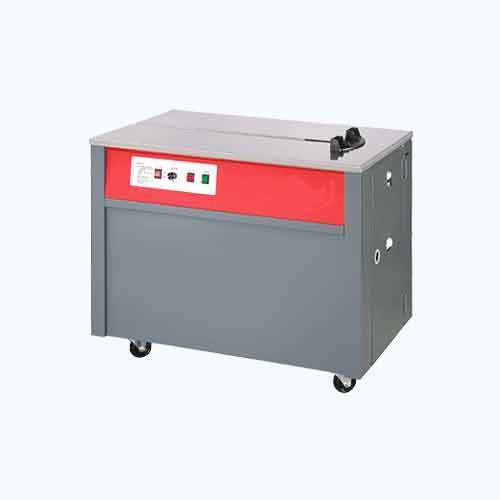 | ₹55000 Product Details: Strap Cycle Speed 1.5 sec./ strap (30 - 40 Straps/min.) Power Supply 1220V 50 Hz 350 W Dimensions (mm) 900(W) x 580(D) x 750(H)... View product → |
Frequently asked questions
What should you check first when a semi-automatic strapping machine stops working?
Switch off and isolate power, then check the strap coil, emergency stop, threading, strap guides, and visible obstructions.
How can you separate a strap-feed issue from an electrical failure?
Inspect the coil, threading, guides, and feed path first. If the motor, controls, or indicators do not respond after those checks, treat it as an electrical fault.
Why does a semi-automatic strap seal become weak, open, or burnt?
Incorrect strap settings, mismatched strap material, dirty or worn sealing parts, and excessive heating or tension can cause poor seals.
When should you request semi-automatic strapping machine repair in Pune?
Request a trained technician for exposed wiring, failed controls, motor faults, repeated seal failures, damaged heaters, or faults that return after basic checks.