
The right choice depends less on the number of chambers than on how your team loads pouches, handles products and meets its saleable packs-per-hour target. You will be able to compare workflow, real capacity, product suitability, installation demands and supplier trial requirements before choosing equipment for a Delhi packing operation.
Key takeaways
- Choose double chamber equipment when one operator must load while another chamber runs.
- Calculate output from cycle time, pouch count, and actual operating hours.
- Test the product, pouch, vacuum level, and seal settings before buying.
- Compare installation, utilities, training, and service alongside the machine price.
How single- and double-chamber machines handle the same pouch
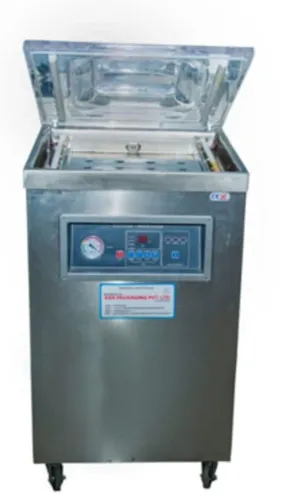
The practical difference is whether the operator waits for one chamber to finish or uses a second chamber during that cycle. In a single chamber vacuum machine, place the pouch inside, close the lid, evacuate air, seal the pouch, vent the chamber, open the lid and remove the pack. The chamber stays occupied throughout.
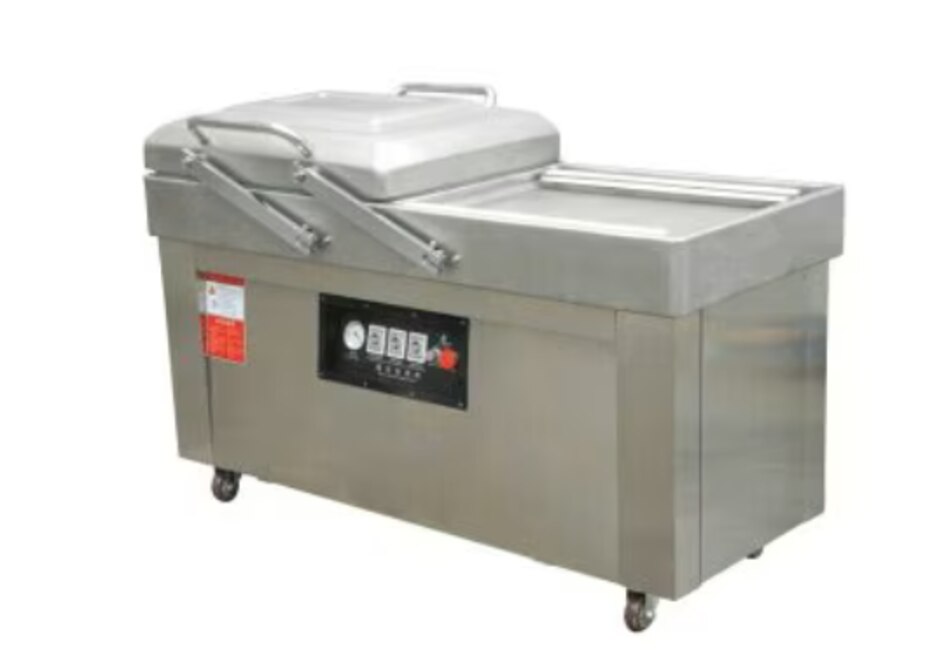
A double-chamber vacuum packing machine in Delhi has two alternating work chambers. Load one chamber while the other evacuates, seals and cools; then switch sides. This overlaps handling with machine time, but does not guarantee better vacuum quality or twice the output.
| Configuration | Operator and machine effect | What to check |
|---|---|---|
| Single chamber | One lid and one work area; the operator waits between cycles | Compact footprint, simple access and lower purchase complexity |
| Double chamber | Two work areas; the operator moves between lids while cycles alternate | Larger footprint, more movement and faster loading rhythm |
| Shared pump | Both chambers depend on one vacuum system | Confirm whether simultaneous use changes pump-down time |
| Independent pumps | Each chamber has its own vacuum system | Check service cost, controls and whether both pumps are needed |
For a single chamber vacuum machine comparison, measure usable chamber size, seal-bar layout and operator loading time, not chamber count alone. A double chamber earns its space when repeated loading keeps the pump busy; it adds little when weighing, filling, arranging or inspection takes longer than vacuuming.
Ask whether both chambers share one pump or have independent pumps before comparing cycle claims.
Choose by workload, not by the advertised chamber count
Choose a single chamber for low-volume, intermittent, varied or space-constrained packing, especially when one operator changes products frequently. Choose a double chamber for repeated batches, two-person loading or continuous work, where the next pouch can be prepared while the current cycle runs.
| Configuration | Practical advantage | Choose it when |
|---|---|---|
| Single chamber | Lower footprint and simpler purchase; one operator places the pouch, closes the lid, waits through vacuuming and sealing, then removes it | Product changes are frequent or output is modest |
| Double chamber | Alternating chambers overlap loading with vacuuming and sealing | Repeated batches justify faster handling and available floor space |
| Double chamber | Shared or independent pumps affect recovery and cycle time | Ask which arrangement the quoted machine uses |
For a single chamber vacuum machine comparison, calculate cycles per hour multiplied by saleable packs per cycle, not chamber count. A double chamber does not automatically produce twice as much: pouch size, product type, target vacuum, seal dwell, cooling time, loading skill and operator count determine actual output.
A larger single chamber can win if it seals more pouches per cycle.
The second chamber adds no benefit when weighing, filling, arranging, trimming or product inspection takes longer than vacuuming and sealing. Test that bottleneck before buying.
For a packaging machine supplier double chamber vacuum machine for comparison in delhi, request actual cycles per hour with your pouch and product, and record rejects rather than relying on the advertised pump size.
Calculate capacity and check whether the product is a good vacuum candidate
Calculate saleable packs per hour as demand divided by available production hours, then add allowances for leaks, damaged pouches and changeovers. If demand is 800 packs across eight hours and expected losses total 10%, plan for 111 saleable-capacity packs per hour: 800 ÷ 8 ÷ 0.90.
Confirm whether the stated output assumes one pouch or several per chamber and one operator or two.
- Ask whether the product is meat, cheese, cooked food, dry food, garments or a component.
- Check liquids and sauces for boil-over and pump carryover; use liquid controls, adequate pouch headspace and disciplined pouch positioning.
- Check sharp edges for punctures, powders for contamination of the seal, fragile products for crushing and easily crushed items for excessive vacuum.
- Reject vacuum as the wrong process when the pack collapses the product, damages its appearance or cannot maintain a leak-free seal.
| Product or condition | Main risk | What to verify |
|---|---|---|
| Liquids or sauces | Product enters the pump | Liquid-control setting, headspace and operator technique |
| Sharp-edged component | Pouch puncture | Protective packing and leak testing |
| Powder | Powder reaches seal | Clean seal area and suitable pouch |
| Fragile or crushed item | Deformation | Lower vacuum target and trial results |
For irregular pouch contents and liquids, a chamber machine is usually more forgiving than an external nozzle, but only with those controls. Specify absolute pressure in mbar or kPa, not “percentage vacuum”; deeper vacuum is not automatically better. Gas flushing is separate: confirm nitrogen or carbon-dioxide controls, headspace and residual-oxygen testing.
Refrigerated vacuum-packed meat, cheese and cooked food need validated temperature and shelf-life controls; a stronger pump is not a safety validation. This applies when comparing a double chamber vacuum packing machine in delhi.
Compare the machine, pouch and installation as one operating system
A sound single chamber vacuum machine comparison measures the pouch, product and service burden together. Compare usable chamber dimensions, seal-bar length, actual pouch fit, pump-down time, seal and cooling time, and whether both chambers share one pump or use independent pumps.
| Option | Operating consequence | Check before purchase |
|---|---|---|
| Single chamber | One pouch cycle occupies the chamber from evacuation through venting | Confirm operator loading time and lid access |
| Double chamber | One chamber can load while the other vacuums and seals | Confirm both chambers maintain the quoted cycle time |
| Either layout | Pump horsepower alone does not predict output | Check headspace, wet product, cooling and manual loading limits |
Require these service details in the quotation: vacuum-sensor access, cleaning access, removable seal wires or elements, lid-gasket replacement method, pump-oil service interval and moisture filtration. Wet products can contaminate oil, reduce vacuum performance and damage the pump despite a large motor.
Require the electrical configuration in writing: voltage, phase, frequency, connected load, isolator or plug arrangement and protection requirements. Match the nameplate to the Delhi site supply, especially before selecting larger three-phase equipment.
For food packing, verify the pouch and every food-contact component against the FSSAI Packaging Regulations. Request seal tests using the actual laminate and product: ASTM F88/F88M for seal strength, ASTM F1929/F1929M for channel leaks where applicable, and ASTM F2096/F2096M for gross leaks. A wide seal bar is not proof of a reliable seal.
Use a witnessed trial to choose a Delhi vacuum-equipment supplier
Do not approve a quotation from catalogue vacuum figures alone. Require a witnessed trial with your actual product temperature, fill weight, pouch material, pouch dimensions and target cycle, then sign an acceptance record.
Record:
- Achieved absolute pressure in mbar or kPa
- Cycle time and saleable packs per cycle
- Seal appearance and leak-test results
- Residual oxygen when gas flushing is specified
- Performance after repeated cycles, including vacuum recovery and seal consistency
Ask the vacuum packaging equipment supplier in delhi whether the output assumes one operator or two, one pouch or several pouches per chamber, and a shared pump or independent pumps. A second chamber does not prove independent evacuation or twice the output.
| Trial question | Why it matters | Evidence to request |
|---|---|---|
| How is output calculated? | Handling, filling or cooling can limit production | Observed cycles per hour × saleable packs per cycle |
| What happens with both chambers running? | A shared pump can slow evacuation | Pressure and cycle records for each chamber |
| What support is included? | Downtime continues after installation | Training, spare seal elements, gaskets, oil and response time |
If your search is “packaging machine supplier double chamber vacuum machine for comparison in delhi,” compare demonstrated production results, not chamber count. ASN Packaging PVT LTD belongs in that comparison when its trial results and equipment match your application.
Frequently asked questions
What is the practical difference between a single- and double-chamber vacuum machine?
A single chamber stays occupied while the pouch is evacuated, sealed, vented, and removed. A double chamber lets the operator load one chamber while the other completes its cycle, reducing waiting between loads.
How should you choose between a single and double chamber vacuum machine?
Choose by workload rather than chamber count. Compare required packs per hour, pouch size, number of pouches per cycle, operator movement, cycle time, and available floor space.
How do you calculate vacuum packing capacity?
Measure the complete cycle, count the pouches loaded per cycle, and multiply cycles by pouches per cycle across the planned operating hours. Use observed trial results instead of the nameplate rate.
Is every product suitable for vacuum packaging?
Check whether the product tolerates compression, air removal, and the selected seal temperature. Review product shape, moisture, sharp edges, gas release, and the pouch film before selecting the equipment.
What should you test before choosing a Delhi vacuum-equipment supplier?
Run a witnessed trial using your product and production pouch. Check vacuum performance, seal strength, leakage, cycle time, operator handling, installation needs, training, and service support.