
Food packers need to stabilise cartons without crushing corners, weakening seals or introducing contamination around the packing line. By the end, you will know how the machine is operated, which strap and hygiene details to specify, how to test seal quality, and how to compare a Delhi supplier’s quotation with the real cost of ownership.
Key takeaways
- Confirm carton size, PP strap width and load weight before requesting a quote.
- Test strap tension and heat settings on sealed cartons from your production line.
- Ask the supplier for a live trial, spare-parts list and service response terms.
- Choose semi-automatic handling when an operator can position each carton consistently.
What the operator does during each strapping cycle
The operator squares the corrugated carton, places it on the table and passes PP strap around or under the load. Both strap ends then go into the sealing head or guide channel before the operator starts the cycle.
- Use one strap to stabilise a carton.
- Add straps to bundle cases.
- Strap stacked cartons so they stay aligned.
- Secure a finished load for dispatch.
After starting, the machine tensions the strap, heat-seals the overlap and cuts the strap. The operator checks for an even joint, removes the carton and repeats the process.
A semi automatic strapping machine in delhi does not form an arch around each package; an automatic arch machine feeds and positions the strap with less manual presentation.
| Handling point | Practical effect on output |
|---|---|
| Carton positioning | A square carton feeds smoothly; a skewed carton wastes time and produces poor strap alignment. |
| Corner protection | Protectors prevent crushed edges but add loading time and need correct placement. |
| Misfeed | The operator must stop, remove or rethread the strap, and restart the cycle. |
| Roll change | Production pauses while the new roll is fitted and threaded. |
A published cycle time describes machine tensioning, sealing and cutting, not complete handling. Time loading, squaring, protection, inspection, removal, misfeed recovery and roll changes before estimating cartons per hour.
Specify the strap and carton conditions before you buy
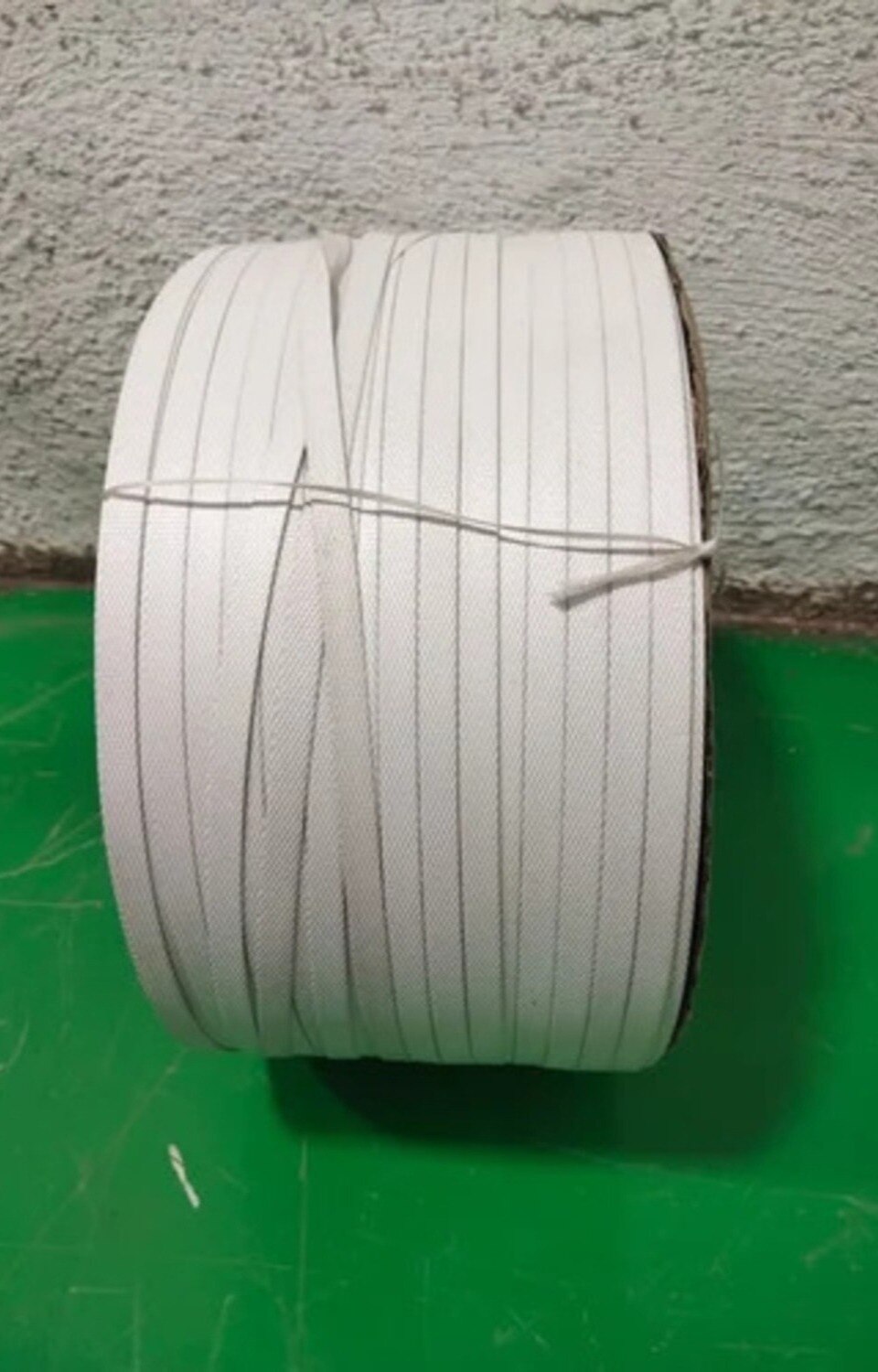
A nominal 12 mm strap does not prove compatibility. A food carton strapping machine can reject that roll if its thickness, embossing, edge finish or outside diameter exceeds the guide channel, tension wheel or heater adjustment range.
Ask the supplier to confirm these specifications in writing:
- Strap material: polypropylene (PP), polyester (PET), or both.
- Strap width and thickness, including the permitted tolerance.
- Core diameter, maximum roll outside diameter and maximum roll weight.
- Tension range, sealing method and heater adjustment range.
- Carton dimensions, table clearance and any limits for dusty or moisture-exposed packs.
PP suits light and medium corrugated cartons because it is compliant and economical. PET retains more tension for heavy or rigid loads, but a sealing head designed for PP must not be assumed to seal PET correctly.
The strap normally touches the carton exterior, not the food. A machine suitable for food-packaging operations is therefore not the same as a food-contact strap; direct-contact claims require a material declaration from the strap manufacturer. For flour, grains, spices, oil-packed cartons, chilled goods and frozen products, inspect dust, moisture, condensation and adhesive residue.
Keep product away from the strap path, clean the table and channels, and prevent lubricant or metal fragments from reaching cartons. Use a cleaning procedure that removes contamination without blowing it across the packing area.
Set tension and heat for a seal that survives handling
The safest seal uses the lowest tension that keeps the carton stable during lifting and movement. Excess tension cuts into printed packaging, crushes corners, reduces carton height, distorts contents or breaks the strap at the joint.
1. Start with a low tension setting. Increase it in small steps until an irregular load remains restrained without loosening. Stop as soon as the carton is secure; maximum tension is not the target.
2. Match heater temperature and cooling or dwell time to the strap grade and thickness through a controlled trial. Do not copy a setting from another PP thickness, or use a PP setting for PET.
3. Inspect the weld across the overlap. It must form a continuous, even bond. A weak seal opens during a manual pull; an overheated seal can look glossy, thin or brittle and deform the strap beside the joint. Unbonded areas or separation with light force indicate an incomplete weld.
4. Record the strap specification, tension setting, heat setting, dwell or cooling time and carton type. Pull-test sample cartons by hand at minimum, or use a force gauge when you need repeatable acceptance. Appearance alone cannot prove seal strength.
Keep the heater, sealing blade and strap path free from dust and adhesive residue. Contamination can create a joint that looks closed but fails under handling. Reject the setting if the carton deforms, the strap loosens, or the weld separates, then repeat the trial after correcting the cause.
Compare a Delhi supplier by trial evidence, parts and price
Do not approve a quotation until the supplier straps your actual carton. Require the trial to use its dimensions, strap grade, roll and number of straps per carton, then record seal integrity, strap breakage, carton deformation, time per strap, misfeed recovery and the operator’s handling time.
Request these documents and answers from every semi automatic strapping machine supplier:
- Photograph of the nameplate and the installation manual.
- Electrical supply, table height, tension range, sealing method and supported roll dimensions.
- Confirmation of 220–240 V, single-phase, 50 Hz for your Delhi site. If the quotation says 110 V or three-phase, stop and check the nameplate, motor, heater and protection requirements.
- Local response time and post-warranty stock of heater blades, sealing heads, microswitches, belts and tension wheels.
Compare the offers on evidence, not a catalogue speed:
| Item | What to compare | What failure reveals |
|---|---|---|
| Trial | Seal, breakage, deformation, timing and jam recovery | A fast cycle can still produce slow, damaged output |
| Specification | Nameplate, manual, tension, seal and roll limits | An incompatible supply or strap can stop installation |
| Price | Freight, GST, commissioning, voltage protection, spare heater blades, warranty labour and installation | A low semi automatic strap machine price may exclude operating costs |
Ask ASN Packaging PVT LTD for a model-specific demonstration and written service scope, including parts availability after warranty expiry. That test gives a packaging machine supplier semi automatic strapping machine in Delhi a measurable basis for comparison.
Decide when semi-automatic handling is the right investment
Choose semi-automatic handling for moderate volumes, irregular carton presentation, or dispatch work where an employee must inspect, square, label or add corner protection. It avoids the installation complexity of a conveyor-integrated arch system.
| Option | Carton flow | Labour fit | Investment case |
|---|---|---|---|
| Semi-automatic | Irregular sizes and spacing | Operator presents each carton | Lower installation complexity |
| Automatic arch | Consistent stream and narrow size range | Manual presentation is the bottleneck | Higher equipment and installation cost |
Compare total operator time, not the catalogue maximum. Include squaring, corner protection, carton changes, roll replacement, failed seals and clearing strap jams. A fast machine still loses output if the operator spends minutes recovering each misfeed.
Before choosing a semi automatic strapping machine in delhi, calculate straps per carton, cartons per shift, available labour, changeover frequency and the cost of a delayed dispatch. Time a live trial with the carton sizes you actually ship, then record time per strap, seal failures, carton deformation and recovery from a misfeed.
Ask the supplier to repeat the test across each production carton and show recovery without hiding the jam or resetting the machine off-camera. Choose the lowest tension and simplest configuration that secures the load, passes the pull test and keeps the strap path clean.
This gives you a defensible comparison instead of selecting on advertised speed alone.
Frequently asked questions
What does the operator do during a semi-automatic strapping cycle?
The operator squares the carton, positions it on the table, passes PP strap around or under the load, places both strap ends in the sealing head or guide channel, and starts the cycle.
What should you specify before buying a food carton strapping machine?
Provide the carton dimensions, carton weight, strap material and width, load shape, required strap placement, and the carton surface condition, including loose flaps or uneven loads.
How do you set strap tension and heat for a reliable seal?
Set tension high enough to hold the carton without crushing corners, then adjust heat until the PP strap fuses cleanly. Confirm the setting by testing sealed cartons after handling.
How should you compare a semi-automatic strapping machine supplier in Delhi?
Request a trial using your cartons and strap, then compare seal results, cycle handling, replacement parts, service arrangements and the complete semi automatic strap machine price.